
Inclusive language services
Write so more people can recognise themselves in the message.
DEMA reviews and adapts language for inclusion across gender, age, disability, ethnicity and culture, body size, socioeconomic status and other audience dimensions. The objective is clear, respectful communication appropriate to the target language and context, without turning inclusion into a mechanical list of banned words.
Inclusive language is contextual
A neutral choice in one language may not exist in another.
Grammar, culture, community preference and communication purpose all affect the appropriate solution. Inclusion cannot be transferred by word substitution alone.
Where bias enters language
Inclusive communication is broader than gender-neutral job titles.
Everyday wording can unintentionally exclude, stereotype or reduce people to a characteristic across several dimensions.
Age
Avoid wording that treats age as a deficit or assumes one experience applies to every older or younger person.
Disability
Prefer language aligned with community and organisational guidelines, and avoid expressions that turn disability into a metaphor.
Ethnicity & culture
Remove stereotypes, unnecessary labels and wording that treats one cultural reference point as the universal default.
Gender & sexual orientation
Use role names, pronouns and forms that fit the target language, audience and stated identity where known.
Body size & appearance
Avoid value-laden descriptions where size or appearance is not relevant to the communication.
Socioeconomic status
Describe circumstances precisely rather than using labels that imply judgement about people or communities.
Multilingual inclusion
Language families create different constraints.
Gender-inclusive language is language-specific. English can often use neutral job titles directly; many Romance, Germanic and Slavic languages encode grammatical gender; languages such as Estonian, Finnish and Hungarian operate differently again. The strategy has to be chosen in the target language, not copied from English.
Language pattern
Typical strategy
Practical implication
Natural-gender languages
Use neutral role nouns and appropriate pronouns where available.
“Chairperson” or role-first wording may remove unnecessary gender marking.
Grammatical-gender languages
Use feminine/masculine pairs, collective forms, neutral paraphrase or locally accepted inclusive conventions.
The best solution depends on readability, context and current target-language norms.
Genderless languages
Gender marking may be less of a grammatical issue, but other inclusion dimensions still require attention.
Do not assume the content is automatically inclusive because the grammar lacks gender.
Events and insights
Sharing our accessibility expertise with the industry.
Our team speaks at conferences, writes for industry media and runs workshops on plain language, accessibility and inclusion.
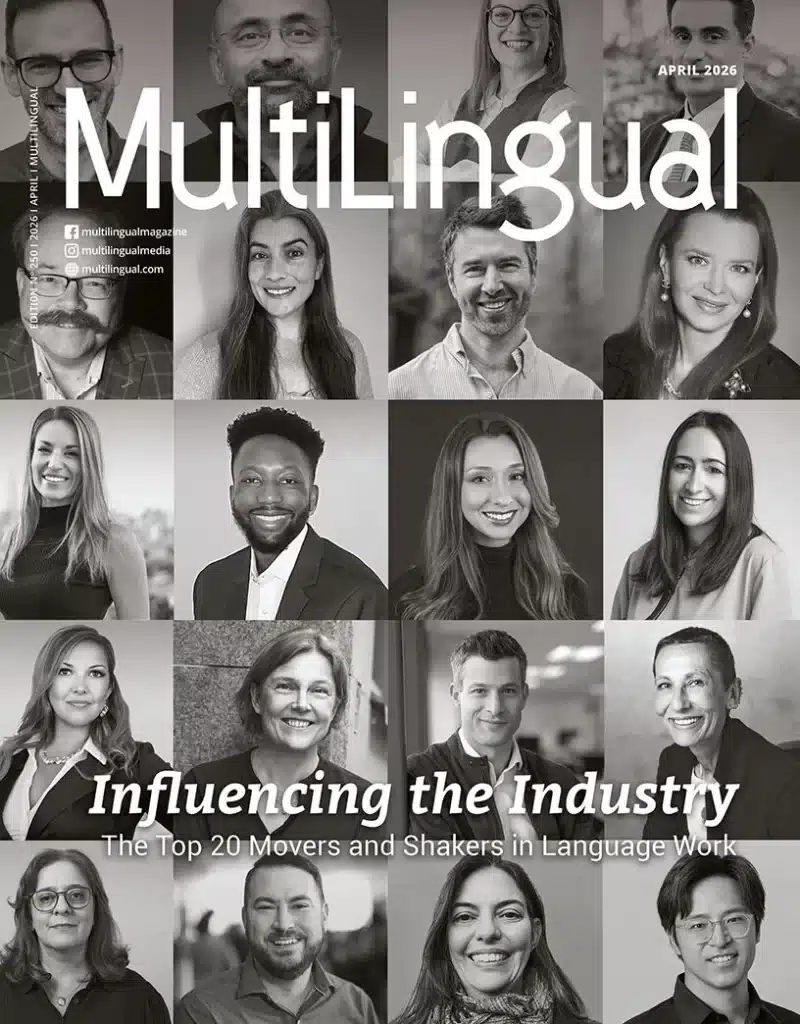 Article · MultiLingual magazine, April 2026
Influencing the Industry
In the April 2026 issue, Milena Spelta Parenti is featured among language industry influencers, explaining why accessible and inclusive language is about removing barriers.
Read the article ↗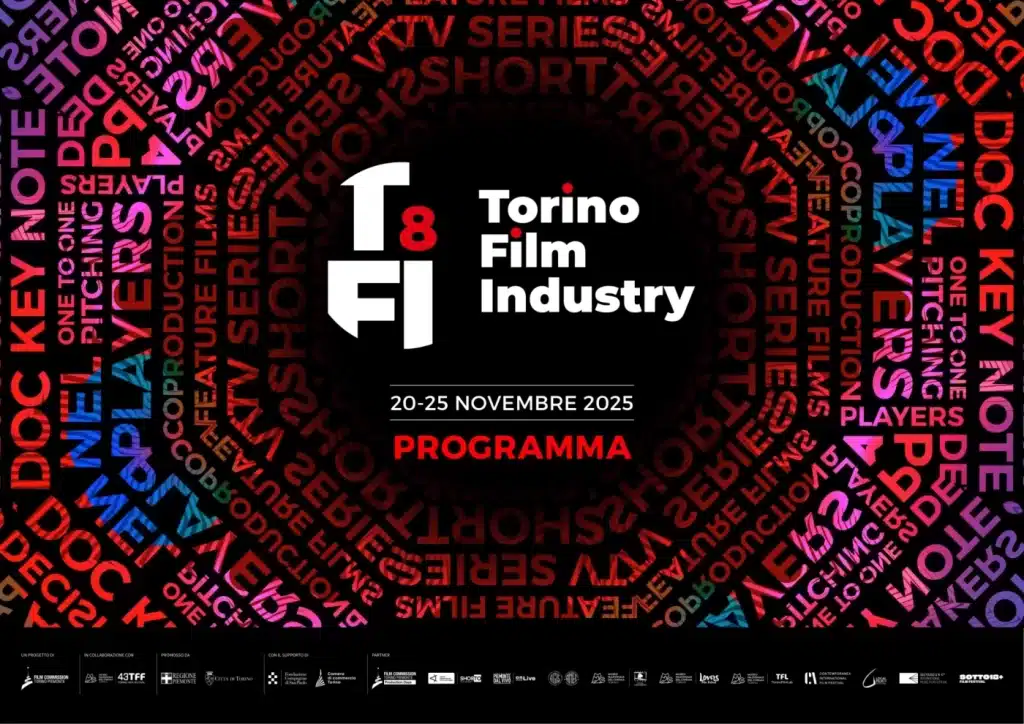 Workshop · Torino Film Festival 2025
Lo spettacolo per tutti: inclusione e innovazione sul palco e sullo schermo
Milena Spelta Parenti took part in this workshop on making theatre and film accessible to every audience, with inclusive and innovative approaches on stage and on screen.
View the programme ↗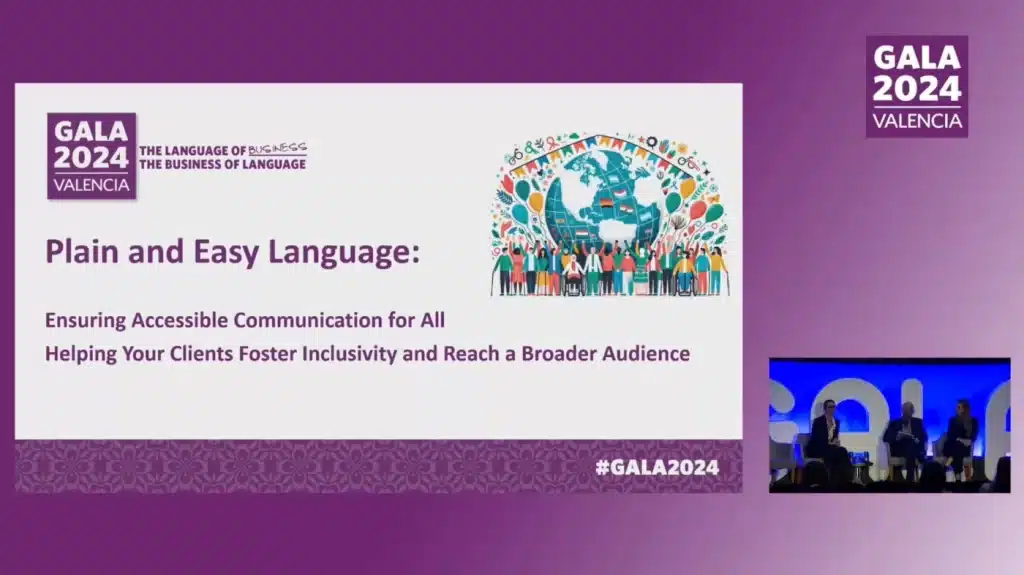 Conference talk · GALA 2024 Valencia
Plain and Easy Language: ensuring accessible communication for all
Milena Spelta Parenti and Jovana Maravic share how we simplify language for specific audiences, drawing on the plain and easy language projects of the Spanish company DEMA acquired in 2022.
Watch the talk ↗
From word list to communication decision
The right question is why the characteristic is mentioned at all.
01
Identify audience and communication purpose
Understand who the content is for, what it needs to achieve and which inclusion guidelines the organisation already follows.
02
Review potential bias points
Look for labels, stereotypes, gendered role terms, metaphors and unnecessary references to personal characteristics.
03
Adapt in the target language
Choose wording that is natural, respectful and workable in that language rather than copying an English inclusive form.
04
Check brand and readability
Inclusive language should remain clear and consistent with the organisation’s communication style.
05
Document preferred choices
For recurring multilingual content, approved inclusive-language decisions can be added to style guides and terminology resources.
Examples
Small wording changes can change the frame of the sentence.
The examples below show the principle in practice. Treat them as suggestions for your context rather than universal rules.
Potentially limiting term
Possible alternative
Why
Blue-collar worker
Skilled tradesworker / manual worker
Can describe the work more directly instead of relying on a social-class shorthand.
White-collar worker
Office worker / knowledge worker
Names the work context more explicitly.
Seniors
Older adults / older people
May be more neutral depending on the audience and style guide.
Chairman
Chair / chairperson
Removes unnecessary gender marking in English.
A note on context
Inclusive language evolves and cannot be reduced to a permanent dictionary.
Geography, community preference, legal context and language change over time. DEMA therefore treats inclusive-language recommendations as audience- and market-specific. For sensitive content, client policy or community guidance should take precedence over generic internet lists.
Research before replacement
Understand the audience and the reason for the recommendation.
Keep readability
An inclusive form that makes the text impossible to read may fail the communication goal.
Maintain multilingual consistency
Document approved choices so different languages do not drift into contradictory policies.
Client voices
Long-term partners, in their own words.
Manufacturers, agencies and specialist firms across Europe rely on us for documentation that has to be right in every market.
“

We have been working with DEMA for a few years now on the translation of manuals: they are a great partner – professional, fast, and efficient, with a team of helpful and kind people. Our native-speaking dealers have also praised the quality and accuracy of the translations.
Michela R.
FMB S.r.l. · Italy
“
The advertising agency that follows us called me to tell me that the layout of the brochures that DEMA SOLUTIONS translated was perfect, he added that the translations never come this way, neither from us nor from their other clients. They were very satisfied.

Fernanda B.
Bonino S.r.l. · Italy
“
DEMA Solutions is a dynamic service provider that responds to our needs and thus puts its customers first. The cooperation with the staff is a pleasure and leads to success.
Tomislav M.
Tanner AG · Germany
“
Our collaboration with Dema has made it possible for us to look at the ‘translation issue’ as nothing more than a formality. Giardina Group is an engineering company that specializes in the design and production of innovative surface finishing and coating technologies. We export 90% of our production, and our ability to communicate with our customers in their own language – by providing clear, precise and professional documents – is a significant competitive advantage and an essential part of the high-quality service for which we are known. Our collaboration with Dema has proven to be of immense value: they are an attentive, reliable partner who responds quickly to our needs, even in ‘emergency’ situations.

Luca R.
Giardina Group · Italy
“
We have had a fruitful long-term cooperation with Link-Up. Over the years, we have put in a lot of hard work and have really made a name for ourselves as an international player in the clothing industry. It has been a non-stop journey, and the quality of multilingual communication in different contexts and for different services has been and continues to be a key strategic factor. Let’s keep up the good work together!
Matteo L.
Teddy Group · Italy
Link-Up is a DEMA Solutions company
“
Translations of outstanding quality, always delivered on time, with professionalism and great availability. As a company operating in many countries worldwide, it is crucial for us to have a reliable and competent translation service provider we can depend on. The specific language requirements of the sector in which we operate are always met.
Elisa C.
TricoBiotos S.p.A. · Italy
“
Lilly and Claudio are first of all friends, but they are also highly professional partners in the field of translation services. Always available and punctual, they have been our go-to for over 25 years for our international customers, who always praise the quality of our work. Translation is about more than just switching from one language to another, it’s about capturing the essence of the product and tailoring it to the target audience. Thank you Link-Up!!

Vincenzo C.
Promos S.n.c. · Italy
Link-Up is a DEMA Solutions company
“
For several years now, we have relied on LINK-UP for the translation of texts for the websites we create and for writing copy for advertising campaigns. The staff and owners of LINK-UP are always very kind and professional. A guarantee of quality.
Denis V.
Adriaweb Strategie Digitali · Italy
Link-Up is a DEMA Solutions company
“
When I first came into contact with REM Traduzioni more than 10 years ago, our roles were reversed. They were our client and commissioned us to develop their company website. We soon began to involve Elisabetta and Gloria in the projects we manage for our customers. Our collaboration has blossomed over time, thanks to their ability to deliver a consistently high-quality, professional service in every situation. REM Traduzioni has always been the partner of choice for us when it comes to multilingual communication.

Giacomo D.
Advertendo Srl · Italy
REM Traduzioni is a DEMA Solutions company
“
I got to know REM Traduzioni a few years ago when I joined the Ferretto Group. Elisabetta and Gloria were already trusted suppliers to the Ferretto Group and after the first few days I knew I would not be disappointed. The quality of the translations provided, the professionalism of the team, and their willingness to take on even the most urgent and complex projects make REM Traduzioni an invaluable partner on which we can rely to develop all our communication projects.

Annachiara B.
Ferretto Group SpA · Italy
REM Traduzioni is a DEMA Solutions company
“
I think I can say that REM Traduzioni has grown with us. We were one of their first customers over 30 years ago, and our ongoing relationship, built on complete trust and mutual respect, has evolved into a true partnership. Elisabetta and Gloria are our trusted translation service providers that we rely on for all of our translation needs and we consider them an integral part of our team.

Alessandro B.
Ufficio Veneto Brevetti · Italy
REM Traduzioni is a DEMA Solutions company
“
REM Traduzioni is our firm’s partner of choice in the field of language services. We rely on REM for some of our most sensitive and important projects and they always deliver on time and with professionalism.
Alessandro C.
Partner – BTLAWS · Italy
REM Traduzioni is a DEMA Solutions company
“
We are happy with your service, which we consider professional and fast
Antonella T.
Rossi & Rivieri · Italy
Free report
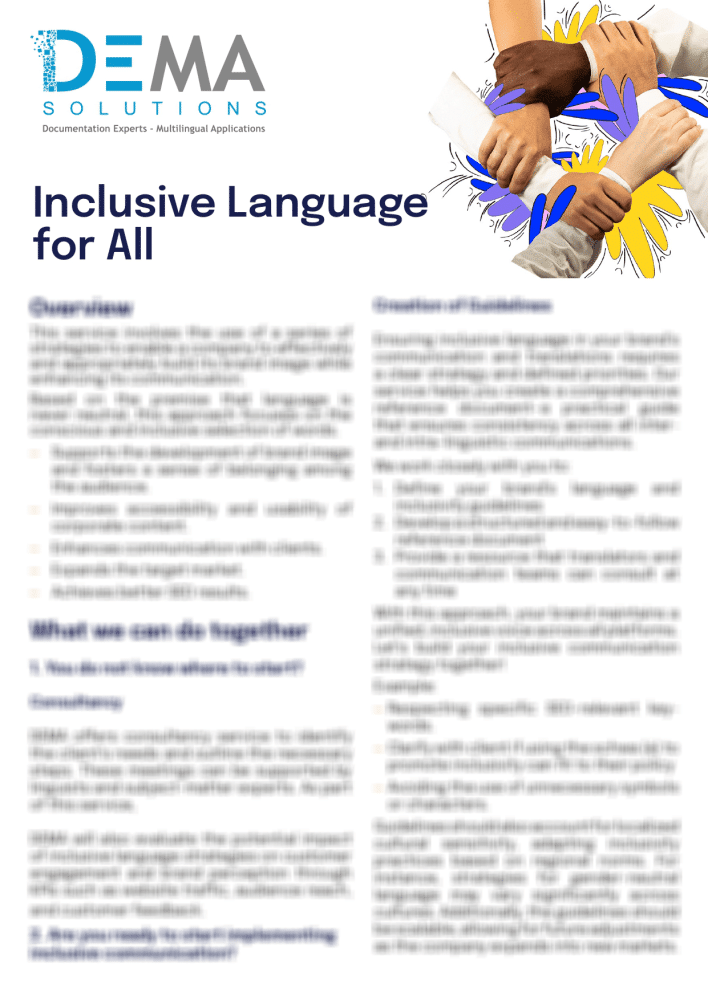
Inclusive language for all.
Download our free report to learn how inclusive language helps your organisation communicate respectfully with every audience, whatever their gender, ethnicity, age or ability.
Questions
Inclusive language is often part of a broader editorial or accessibility policy.
Can you create an inclusive-language guide for our brand?
Yes. Preferred terminology, examples and market-specific conventions can be documented for recurring multilingual content.
Is gender-inclusive wording the same in every language?
No. Grammar and current usage differ significantly. The target-language strategy has to be selected locally.
Can inclusive language be applied to existing translations?
Yes. Existing content can be reviewed for terminology, style and bias patterns, then updated consistently across the relevant language set.
Does inclusive language guarantee legal compliance?
No. Inclusive language is a communication practice. Legal accessibility or non-discrimination obligations depend on the applicable jurisdiction and use case and should be assessed separately.
Build inclusion into the style guide, not only into one campaign.
Share the languages, audiences and existing brand rules. We can identify the areas that need target-language guidance and turn approved choices into reusable editorial standards.
Talk to DEMA